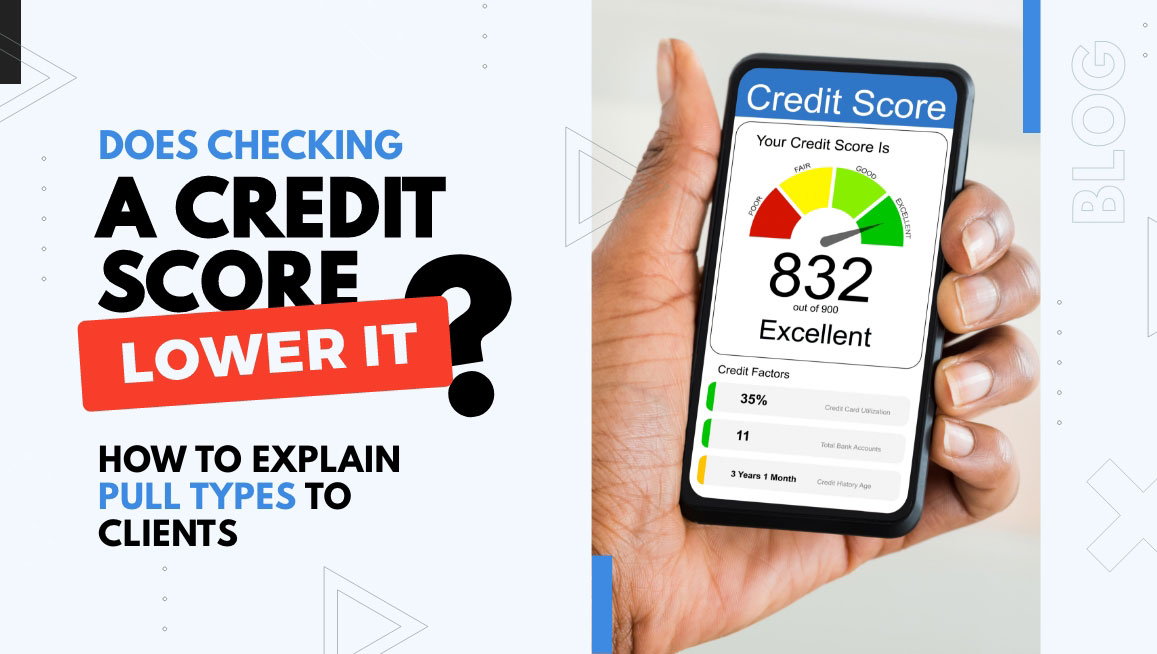
Does Checking a Credit Score Lower It? How to Explain Pull Types to Clients.
by Joshua Carmona
April 15, 2026
12:10 AM
If you run a credit repair business, you’ve definitely heard this question “Does checking your credit score lower it?”
Your team hears it on discovery calls, during onboarding, in DMs, and even in chargeback disputes. Because of this, clients are confused, and that confusion often centers around soft inquiry, hard inquiry, hard credit check, and how often does credit score update.
When your team answers that question clearly and consistently, you:
- Build trust and authority.
- Reduce unrealistic expectations.
- Stay compliant with credit repair laws.
- Protect your business from complaints and regulators
In this blog, written specifically for credit repair business owners, we’ll break down how to explain inquiry types to clients in a way that’s accurate, compliant, and easy to scale using ScoreCEO—your all-in-one credit repair business software with SEO services, websites, and outsourcing support.
Why “Does Checking Your Credit Score Lower It?”Is a Big Deal for Credit Repair Businesses
The phrase “does checking your credit score lower it” sounds simple, but it touches multiple areas of your business:
- Legal compliance
- Client expectations
- Dispute strategy
- Sales and retention
The root of the confusion
Most consumers lump all “credit checks” together. They don’t understand the difference between:
- Checking their own credit score through apps or monitoring services (soft inquiry)
- Applying for a credit card, auto loan, or mortgage (hard inquiry or hard credit check)
So when they ask, “does checking your credit score lower it?”, they might mean:
- “If I log into my credit monitoring app every day, is that bad?”
- “If I shop around with three car dealers, will my score crash?”
- “If you, as my credit repair company, pull my report, does that hurt my score?”
If your team gives vague or inconsistent answers, it can:
- Damage credibility – Clients feel misled if their score moves and they weren’t prepared.
- Create compliance risk – Overpromising what you can do with a hard inquiry can trigger CROA/FCRA issues.
- Increase chargebacks – Misunderstandings around how often does credit score update often lead to “I didn’t get results” claims.
Why education is a core business function, not a “nice to have”
Credit repair businesses that treat education as part of their service—not just dispute letters—tend to:
- Attract higher-quality clients
- Experience fewer complaints
- Build a reputation as trusted advisors rather than “quick-fix” operators
Accurate answers to does checking your credit score lower it, soft inquiry, hard inquiry, and hard credit check form the foundation of that education.
Where ScoreCEO fits in
ScoreCEO helps you operationalize this education so it’s not dependent on one “star” team member. Inside ScoreCEO you can:
- Store standardized scripts about soft inquiry, hard inquiry, and how often does credit score update
- Automate welcome emails that explain inquiries in plain language
- Log client questions and responses for internal training and compliance evidence
You’re not just telling clients the right thing once—you’re building a repeatable, documented system.
How Credit Scores and Updates Really Work (So Your Team Can Explain Them)
Before your staff can confidently answer “does checking your credit score lower it”, they need a working understanding of how scores and updates behave.
Score basics for your team
Most scoring models (like FICO® and VantageScore®) look at similar factors:
- Payment history – On-time vs late payments
- Credit utilization – Balances vs limits
- Length of credit history
- Types of credit – Mix of revolving/installment
- New credit – Including inquiry activity, especially hard inquiry
The “new credit” category is where hard inquiry and hard credit check show up.
How often does credit score update?
Clients want instant results. They make a payment or you send a dispute, and they expect the score to jump overnight. Teaching your team to explain how often does credit score update can prevent frustration and cancellations.
Key points your staff should understand (and teach):
- Scores don’t update on a fixed daily schedule.
They update when new data hits the credit report, which depends on when creditors report to the bureaus.
- Most creditors report monthly.
That means changes to balances, new accounts, or late payments typically impact the score once per billing cycle.
- Inquiries often appear quickly.
When a hard credit check is made (like during a loan application), the inquiry usually shows up on the report within a few days, and the score may reflect it soon after.
This is where how often does credit score update connects directly to client expectations. If they’re checking apps every few hours, they’ll see fluctuations and may panic unless they were educated upfront.
Turning this into a visual lesson
Your team can simplify this explanation with a basic timeline:
- Day 1: Client applies for a loan – hard credit check triggered (hard inquiry).
- Day 2–7: The inquiry appears on the credit report; the score may dip slightly.
- End of cycle: Creditor reports new balance, utilization changes; score updates again.
Inside ScoreCEO, you can:
- First, attach simple visual guides or PDFs to client portals.
- Then, track when you educated each client on how often the credit score updates.
- Finally, log any complaints tied to “my score didn’t change” to improve your scripts.
When your staff understands the mechanics, they can confidently explain why does checking your credit score lower it depends on who is checking and how.
Soft Inquiry vs Hard Inquiry: The Heart of the Question
The clearest way to answer “does checking your credit score lower it” is to separate soft inquiry from hard inquiry (or hard credit check) in your team’s mind and in your client communication.
What is a soft inquiry?
A soft inquiry (also called a soft pull) typically occurs when:
- A client checks their own credit score through a monitoring service or app
- A creditor pre-screens a consumer for marketing offers
- Some existing creditors perform account reviews (depending on the situation)
Key teaching point for your team:
A soft inquiry does not impact the credit score.
That means when a client simply checks their own credit, the answer to “does checking your credit score lower it?” is no—as long as it’s a soft inquiry.
Examples you can use in scripts:
- “When you log into your monitoring account to see your score, that’s a soft inquiry.”
- “When we, as your credit repair company, use a soft pull partner to review your credit, that typically does not affect your credit score.”
What is a hard inquiry (hard credit check)?
A hard inquiry or hard credit check usually occurs when:
- The client applies for a new credit card
- They apply for an auto loan, mortgage, or personal loan
- A lender checks credit as part of an application that may result in a new credit obligation
Key teaching point:
A hard inquiry can affect the credit score, usually by a small, temporary amount.
Important reminders for your team:
- Not every hard inquiry will have a dramatic impact—often it’s a few points.
- Multiple hard inquiries in a short time can signal increased risk and may have a larger effect, depending on the scoring model.
- Some scoring models treat rate shopping (e.g., multiple auto loan inquiries) as one event if done within a specific time window.
Simple comparison your team can use
You can train your staff to use a simple comparison like this:
- Soft inquiry = No score impact
- Example: You checking your own score
- Hard inquiry = Possible small, temporary score drop
- Example: Applying for new credit
So when clients ask “does checking your credit score lower it?”, your team can confidently say:
“If you’re just checking your own score through a soft inquiry, it doesn’t lower it. What can affect your score is a hard inquiry, like when you apply for a loan or credit card.”
Systematizing this in ScoreCEO
ScoreCEO lets you store these definitions and explanations as:
- Script templates for sales and support teams
- Email/SMS templates for onboarding and education sequences
- Internal knowledge base entries your staff can quickly reference
That way, soft inquiry, hard inquiry, hard credit check, and inquiry explanations are consistent across your whole organization—not reinvented in every conversation.
Inquiries and Compliance: FCRA, CROA, and Honest Expectations
Understanding how a hard inquiry affects a score is one part of the job. The other part is explaining it in a way that complies with credit repair regulations.
FCRA and inquiry information
Under the Fair Credit Reporting Act (FCRA):
- Consumers have the right to dispute inaccurate, unverified, or unauthorized inquiries.
- Credit repair businesses can assist with these disputes, but only within the boundaries of the law.
Key compliance points for your team:
- You can dispute a hard inquiry that a client genuinely did not authorize.
- You should not dispute valid, authorized inquiries as “fraud” when they are not.
- You should never guarantee that every inquiry can be removed, especially if it is accurate and verifiable.
CROA and marketing about inquiries
The Credit Repair Organizations Act (CROA) restricts deceptive practices and requires honest, clear disclosures. When it comes to hard inquiry and soft inquiry, your marketing and sales scripts must avoid statements like:
- “We remove every hard inquiry from your report, guaranteed.”
- “We can delete any hard credit check in 30 days, no matter what.”
- “We’ll make it like those inquiries never happened.”
Instead, train your team to use CROA-friendly, honest language, for example:
- “We can review your credit report for potential inaccurate or unauthorized inquiries and help you dispute those under the FCRA.”
- “We cannot legally promise to remove accurate, verifiable inquiries, but we will focus on correcting errors and protecting your rights.”
How does this tie back to “does checking your credit score lower it”?
If you over-simplify the impact of inquiry activity, you may unintentionally mislead clients about:
- Why their score dropped after multiple hard credit checks
- Why you can’t delete every hard inquiry they’ve accumulated
- Why how often does credit score update doesn’t equal “instant fix”
Accurate, honest explanations reduce the risk of complaints, chargebacks, and regulatory attention.
How ScoreCEO supports compliance
ScoreCEO is built for credit repair businesses that take compliance seriously. You can use it to:
- Standardize compliant marketing language about hard inquiry, soft inquiry, and hard credit check
- Store compliant dispute letter templates that address unauthorized inquiry issues correctly
- Keep a documented history of what was communicated to the client and when
This documentation is not just good practice; it’s part of protecting your business if your explanations or promises are ever questioned.
Practical Scripts: How Your Team Can Explain Inquiry Types and Score Updates
It’s not enough for you, the owner, to understand soft inquiry, hard inquiry, and how often does credit score update. Your entire team needs usable language they can repeat consistently.
Below are example scripts you can store inside ScoreCEO as templates.
Script 1: The Classic Question
Client: “Does checking your credit score lower it?”
Team member:
“Great question. There are two types of credit checks: soft inquiries and hard inquiries.
When you check your own score, that’s usually a soft inquiry, and it does not lower your credit score.
A hard inquiry happens when you apply for new credit—like a credit card, car loan, or mortgage. A hard credit check can lower your score a little for a short time. So checking your score through your app is fine; it’s applying for new credit that can impact your score.”
Script 2: Explaining how often does credit score update
Client: “I paid my credit card yesterday. Why hasn’t my score gone up?”
Team member:
“Credit scores don’t update in real time. They change when your lenders send updated information to the credit bureaus.
Most lenders report about once a month. That’s why how often does credit score update depends on when your creditors send data. Once that new information is on your credit report, the score gets recalculated, and then you’ll see the change in your monitoring app.”
Script 3: Rate shopping and multiple hard inquiries
Client: “I went to three car dealers. Did that destroy my score?”
Team member:
“When you’re shopping for a car or mortgage, the system often understands that you’re rate shopping. However , several hard inquiries within a certain time window can be treated as a single event in some scoring models.
You might still see a small dip from the hard credit checks, but it’s usually temporary. The bigger risk is applying for lots of different types of credit over time, not just comparing rates for one loan.”
Script 4: Disputing unauthorized inquiries
Client: “I don’t recognize this inquiry. Can you remove it?”
Team member:
“We take that seriously. If there’s a hard inquiry you didn’t authorize, we can help you dispute it under the FCRA.
Our focus will be on checking whether the inquiry is accurate and verifiable. If it’s truly unauthorized, we’ll follow the legal process to challenge it. We can’t promise every inquiry will be deleted, but we can work to correct anything that’s wrong.”
Using ScoreCEO to deliver these scripts at scale
With ScoreCEO, you can:
- First, save these scripts as canned responses for phone, email, SMS, and chat
- Then, trigger them automatically through onboarding sequences or educational campaigns
- Finally, train new staff quickly using a centralized script library
That means your answer to “does checking your credit score lower it” is always clear, compliant, and consistent—no matter who takes the call.
Turning Inquiry Education into Systems with ScoreCEO
Knowledge is great—but systems are what protect your business and help you grow. This is where you turn your understanding of soft inquiry, hard inquiry, and how often does credit score update into repeatable workflows.
Example workflow: Inquiry education for new clients
Inside ScoreCEO, you can create a simple workflow like this:
- New client enrolled
- Trigger an automated welcome email that explains:
- The difference between soft inquiry and hard inquiry
- That checking their own score does not lower it
- A short explanation of how often does credit score update
- Onboarding call task
- The system creates a task for the coach/agent:
- “Explain soft vs hard inquiries and manage expectations about score updates.”
- Attach the script directly to the task.
- Education resources in the portal
- Upload a one-page PDF on does checking your credit score lower it and inquiry types.
- Clients can review it anytime without contacting your team.
- Follow-up email sequence
- Over the first 30 days, send short, educational emails that reinforce:
- Why a hard credit check can temporarily drop a score
- Why rate-shopping is different from reckless credit behavior
- Why they may see small fluctuations as how often does credit score update with new data
Managing inquiry disputes with ScoreCEO
You can also create specific dispute workflows for inquiry issues:
- Tag clients who have unauthorized hard inquiry problems
- Use dispute templates focused on unauthorized inquiries under FCRA
- Track bureau responses and deadlines
- Generate reports showing which hard inquiries were successfully corrected or removed
This not only improves results—it gives you data you can use to refine your strategies and marketing claims.
Handling advanced scenarios
Some client scenarios require more nuance, and systems help your team respond correctly:
- Rate shopping for auto/mortgage loans
- Add a knowledge base entry explaining how certain models group multiple hard inquiries made within a short window.
- High volume of inquiries over time
- Train your team to look beyond individual hard credit checks and talk about behavior patterns.
- Clients who fear checking their own score
- Use educational campaigns to reinforce that a soft inquiry from their monitoring app does not lower the score.
ScoreCEO ties all of this together so you’re not relying on memory. Every explanation, script, and inquiry dispute step can be built into your CRM, automated, and measured.
Building a Culture of Credit Education (and How ScoreCEO Supports It)
At the end of the day, the question “does checking your credit score lower it” is bigger than just one interaction. It’s a test of your company’s education culture.
Why education-first credit repair businesses win
>When you invest in client education around soft inquiry, hard inquiry, hard credit check, and how often does credit score update, your business benefits in multiple ways:
- Fewer misunderstandings and complaints
Clients know what to expect from their scores and your services.
- Better retention and referrals
Educated clients are more patient, realistic, and loyal—they appreciate honesty.
- Stronger online reputation
Satisfied, informed clients leave better reviews and are less likely to file disputes or chargebacks.
- Lower compliance risk
Clear documentation and honest explanations reduce the chances of regulators viewing your practices as deceptive.
Practical steps to build that culture
As an owner or leader, you can:
- Train every team member on what an inquiry is and the difference between soft inquiry and hard inquiry
- Require that each onboarding call includes a short, standardized explanation of does checking your credit score lower it
- Review your marketing copy, ads, and website to make sure you’re not overpromising about removing hard inquiries
- >Add regular internal training sessions on FCRA, CROA, and compliant ways to discuss hard credit check and how often does credit score update
How ScoreCEO strengthens that culture
ScoreCEO isn’t just software—it’s the backbone of your education and compliance efforts. With ScoreCEO you can:
- Centralize all your educational content related to does checking your credit score lower it, soft inquiry, hard inquiry, hard credit check, and how often does credit score update
- Automate client education through email sequences, SMS, and portal resources
- Track communication so you can prove you provided honest, clear information
- Use our SEO services and credit repair business websites to publish compliant educational content that attracts better leads
- Leverage credit repair outsourcing services when your internal team needs support implementing these systems
Final takeaway of ( Does Checking a Credit Score Lower It)
Finally, does checking your credit score lower it?
- Checking your own score through a soft inquiry does not lower it.
- A hard credit check—when applying for new credit—can lower the score slightly and temporarily.
- How often does credit score update depends on when creditors report new information, not on how often clients open their app.
When your credit repair business explains these truths clearly, documents them properly, and reinforces them through systems like ScoreCEO, you’re not just fixing credit reports—you’re building a compliant, education-driven brand that clients can trust for the long term.
FAQ’S:
- Does checking your credit score lower it for my clients?
No. When clients check their own score, it’s a soft inquiry and does not lower their credit score. However, a hard inquiry (like applying for a loan or credit card) can cause a small, temporary drop. - How should my team explain the difference between a soft inquiry and a hard inquiry?
- Soft inquiry: Checking your own credit or pre-approvals – no impact on the score.
- Hard inquiry (hard credit check): Applying for new credit – may slightly lower the score.
However, You can save this script in ScoreCEO so everyone explains it the same way.
- How often does credit score update, and how do we manage client expectations?
Scores update when lenders report to the bureaus, not when clients open their app. Most report about once a month, so changes can take a full billing cycle. Use ScoreCEO onboarding emails and call scripts to set this expectation early.
- Can a credit repair business legally remove hard inquiries from a client’s report?
You can dispute inaccurate or unauthorized hard inquiries under the FCRA, but you cannot guarantee removal of every valid inquiry. Make this clear in your marketing and scripts to stay CROA-compliant.
Table of Contents
Explore More Insights
Dive deeper into a wealth of knowledge. Discover a multitude of articles covering diverse topics, expert perspectives, and the latest trends. Feed your curiosity and expand your understanding.